
Where Technology and Writing Come Together
Tools, Ideas & Digital Creativity
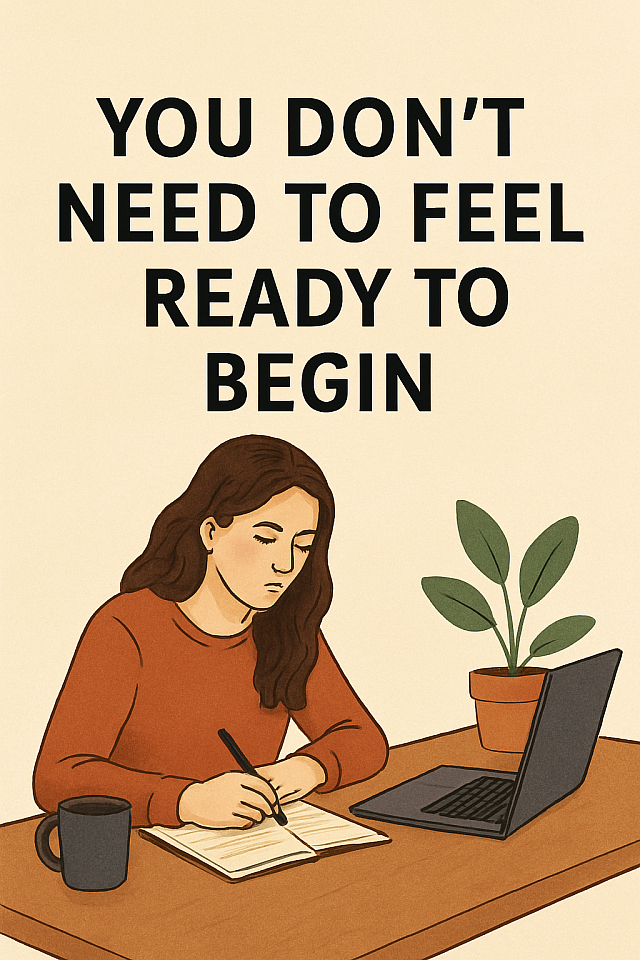
You Don’t Need to Feel Ready to Begin
There is a quiet lie many of us believe, often without realizing it. It sounds reasonable. Responsible, even. The lie says: “I’ll start when I feel ready.”
Ready enough. Confident enough. Prepared enough. Less afraid. More skilled. More certain.
The image in front of us tells a different story.
A person sits at a simple desk, pen in hand, laptop open. There is no dramatic background, no visible success, no moment of triumph. Just someone beginning. Above them, the words read clearly: You don’t need to feel ready to begin.
It’s a message that challenges one of our most common habits waiting.
The Myth of Readiness
We are taught, directly and indirectly, that readiness comes first. That before we take action, we must feel confident. Before we create, we must feel inspired. Before we change, we must feel certain.
But readiness is not a prerequisite for action. More often than not, it is a result of action.
Think about the first time you tried something meaningful. Writing. Learning a new skill. Applying for a job. Speaking up. You probably didn’t feel ready. You felt unsure. Maybe nervous. Maybe clumsy. Maybe afraid of being seen trying.
And yet, you began anyway or wished you had.
The truth is uncomfortable but freeing: no one starts ready. People start confused. People start with half-formed ideas and shaky hands. People start with doubts louder than their confidence.
Readiness is not something you wait for. It’s something you build by starting.
Why Waiting Feels Safe (But Isn’t)
Waiting feels safe because it protects us from failure. If we don’t begin, we can’t mess up. If we don’t try, we can’t be judged. If we stay in preparation mode, we can tell ourselves we’re being responsible.
But there is a hidden cost to waiting: stagnation.
Every day you postpone starting, you reinforce the idea that fear is in charge. That discomfort gets to decide when you move. Over time, waiting doesn’t make things easier it makes starting feel even harder.
The longer you wait, the bigger the task becomes in your mind. The idea grows heavier. Expectations pile up. The pressure increases. What once felt like a simple beginning now feels like a performance.
Starting early, imperfectly, breaks that cycle.
The Quiet Power of Beginning Small
The image shows a person writing in a notebook. Not publishing a bestseller. Not launching a startup. Just writing.
This matters.
Big goals often scare us because we imagine them in their final form. We picture the finished product, the polished result, the moment where everything must make sense. That vision can be paralyzing.
But beginnings are small by nature.
A single sentence. A single line of code. A single page. A single decision. A single honest attempt.
You don’t need clarity for the entire journey. You only need enough courage for the next step.
Small beginnings are powerful because they are manageable. They don’t demand perfection. They don’t require certainty. They only ask for participation.
Confidence Is Built, Not Found
One of the biggest misconceptions about creative and personal growth is that confident people start, while unconfident people wait.
In reality, confidence grows after you begin.
Confidence is built by showing up when you don’t feel like it. By seeing that you can survive mistakes. By learning that imperfection doesn’t destroy you. By proving, through experience, that you are capable of continuing.
Every time you start without feeling ready, you send yourself a powerful message: I can move forward even when I’m unsure.
That message compounds.
Over time, confidence stops being something you chase and becomes something you carry.
Fear Doesn’t Disappear It Changes
Many people wait for fear to go away before they begin. But fear rarely disappears completely. It evolves.
At the beginning, fear sounds like:
- What if I’m not good enough?
- What if I fail?
- What if people judge me?
- After you start, fear changes its tone:
- What if I can improve this?
- What if I keep going?
- What if this actually matters?
The second kind of fear is healthier. It keeps you alert instead of frozen. It encourages growth instead of avoidance.
You don’t overcome fear by eliminating it. You overcome fear by walking alongside it.
Creativity Lives in Motion
Creativity is not a lightning strike. It is not something that only visits the prepared. Creativity responds to movement.
When you begin even awkwardly your mind starts solving problems. Ideas connect. Clarity forms. Momentum builds.
Many people say they are “waiting for inspiration,” but inspiration often arrives after action, not before it. Sitting down to work invites creativity. Avoiding the work starves it.
The person in the image is not waiting for the perfect thought. They are thinking by doing. Writing by writing.
That is how real creation happens.
Progress Over Perfection
Perfection is one of the most convincing reasons we delay starting. We tell ourselves we want to do things “right.” That we’re waiting until conditions are ideal.
But perfection is not a standard it’s a moving target.
When you aim for perfection at the beginning, you place impossible demands on yourself. You expect beginner actions to produce expert results. When that doesn’t happen, you feel discouraged and stop.
Progress, on the other hand, is achievable. Progress allows mistakes. Progress values learning. Progress understands that improvement happens through repetition, not planning alone.
Starting imperfectly is not a flaw. It is the only way forward.
The Emotional Weight of Beginning
Starting something new often brings unexpected emotions. Vulnerability. Self-doubt. Impatience. Even grief for time you feel you’ve already lost.
These emotions don’t mean you’re doing something wrong. They mean you’re stepping into unfamiliar territory.
Growth feels uncomfortable because it stretches your identity. It asks you to leave the safety of what you already know. It challenges the stories you’ve told yourself about who you are and what you’re capable of.
Beginning is an emotional act, not just a practical one.
Acknowledging that makes the process kinder.
You Are Allowed to Learn in Public
Another reason we hesitate to begin is the fear of being seen while we’re still learning. We compare our starting point to someone else’s highlight reel. We assume our early work will be judged harshly.
But everyone you admire once created things they would never show today.
Learning is not something to hide. It is evidence of effort.
You don’t owe the world a flawless version of yourself. You owe yourself the chance to grow.
Momentum Changes Everything
There is a noticeable difference between someone who hasn’t started and someone who has begun even if the progress is minimal.
Once you start:
- You have something to respond to.
- You can adjust, refine, improve.
- You gain feedback from reality, not imagination.
- Momentum doesn’t require speed. It requires consistency.
A small action taken repeatedly outperforms a perfect plan that never leaves your head.
Beginning Is an Act of Self-Trust
When you start without feeling ready, you make a quiet promise to yourself: I trust myself enough to figure this out as I go.
That trust is powerful.
It shifts your mindset from “I need permission” to “I can learn.” From “I must know everything” to “I can adapt.” From “I might fail” to “I will grow.”
Self-trust is built through experience, not reassurance.
You Don’t Have to Finish Today
Starting doesn’t mean committing to the entire journey at once. It means opening the door.
- You don’t need to see the end. You don’t need to know how it will turn out. You don’t need to be sure it will succeed.
- You only need to begin.
- You can pause later. You can change direction later. You can stop if needed.
But without starting, nothing changes.
The Image as a Reminder
The simplicity of the image matters. It’s not dramatic. It’s not loud. It’s gentle and grounded.
It reminds us that beginnings don’t need applause. They don’t need validation. They don’t need certainty.
They need presence.
A desk. A moment. A decision to try.
